Buying Guide for the Best Mouse Sanders
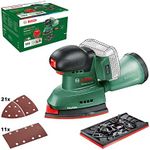
When choosing a mouse sander, it's important to consider the specific tasks you plan to undertake. Mouse sanders are versatile tools ideal for sanding in tight spaces and on detailed workpieces. They are compact, easy to handle, and can be used for a variety of projects, from furniture refinishing to small craft projects. Understanding the key specifications will help you select a sander that best fits your needs, ensuring efficiency and satisfaction in your work.Power SourceMouse sanders can be powered by electricity or batteries. Electric sanders are typically more powerful and are suitable for longer, continuous use. They require a power outlet, which can limit mobility. Battery-powered sanders offer greater flexibility and portability, making them ideal for outdoor or remote work. However, they may have less power and require recharging. Consider where and how often you'll use the sander to decide which power source is best for you.
Motor PowerMotor power in mouse sanders is measured in amps for corded models and volts for cordless models. Higher power means the sander can handle tougher materials and larger surfaces more efficiently. For light-duty tasks like finishing or working on soft woods, a lower power sander will suffice. For more demanding tasks, such as removing paint or working on hardwoods, a higher power sander is recommended. Assess the types of projects you plan to tackle to determine the appropriate motor power.
SpeedThe speed of a mouse sander is measured in orbits per minute (OPM). Higher speeds allow for faster material removal, while lower speeds offer more control and precision. Some models offer variable speed settings, which provide flexibility for different tasks. If you plan to work on a variety of projects, a sander with adjustable speed settings can be beneficial. For specific tasks like detailed work or finishing, a lower speed may be more suitable.
Dust CollectionDust collection is an important feature in mouse sanders as it helps keep your workspace clean and reduces airborne particles. Some models come with built-in dust collection systems or can be connected to a vacuum. Effective dust collection improves visibility and reduces cleanup time. If you work in a small or enclosed space, or if you are sensitive to dust, prioritize a sander with a good dust collection system.
ErgonomicsErgonomics refers to the design of the sander and how comfortable it is to use. A well-designed sander will have a comfortable grip, be lightweight, and easy to maneuver. This is especially important for extended use, as it reduces fatigue and improves control. Consider the size and shape of the sander, and if possible, try holding it to see how it feels in your hand. Choose a model that feels comfortable and balanced for your hand size and strength.
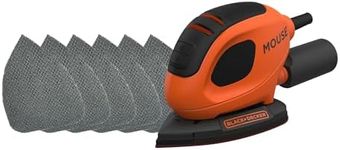
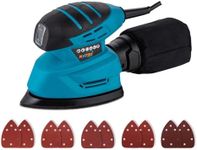
Pad Size and ShapeMouse sanders typically have a triangular pad shape, which is ideal for reaching into corners and tight spaces. The size of the pad can affect the sander's ability to work on different surfaces. Smaller pads are better for detailed work and intricate areas, while larger pads can cover more surface area quickly. Consider the types of projects you will be working on to determine the most suitable pad size and shape for your needs.