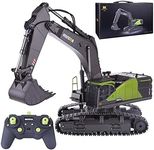
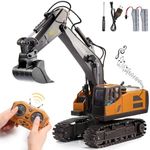
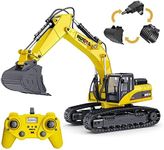
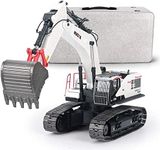
Buying Guide for the Best Rc Excavator
Choosing the right RC excavator can be a fun and rewarding experience, especially if you know what to look for. RC excavators come in various sizes, capabilities, and price ranges, so it's important to understand your needs and preferences before making a purchase. Whether you're buying for a hobby, a gift, or a specific project, considering the key specifications will help you find the best fit for you.ScaleThe scale of an RC excavator refers to its size in relation to the real-life version. Common scales include 1:14, 1:16, and 1:20. A larger scale (e.g., 1:14) means a bigger model, which can offer more detail and realism but may require more space to operate. Smaller scales (e.g., 1:20) are more compact and easier to handle, making them suitable for indoor use or smaller outdoor areas. Choose a scale based on where you plan to use the excavator and how much detail you want.
MaterialRC excavators can be made from plastic, metal, or a combination of both. Plastic models are generally lighter and more affordable, making them a good choice for beginners or casual users. Metal models are more durable and can handle tougher tasks, making them ideal for more serious hobbyists or those who plan to use the excavator frequently. Consider how you will use the excavator and choose a material that matches your needs for durability and performance.
Motor TypeThe motor type in an RC excavator can be either brushed or brushless. Brushed motors are more common and less expensive, but they tend to wear out faster and require more maintenance. Brushless motors are more efficient, have a longer lifespan, and provide better performance, but they come at a higher cost. If you plan to use the excavator frequently or for more demanding tasks, a brushless motor may be worth the investment. For occasional use, a brushed motor should suffice.
Battery LifeBattery life determines how long you can operate the RC excavator before needing to recharge. This is usually measured in minutes of runtime. Longer battery life means more uninterrupted playtime, which is especially important for extended projects or outdoor use. Look for models with battery life that matches your intended use. For casual play, 20-30 minutes may be sufficient, while more serious users might prefer 40 minutes or more. Additionally, consider models with replaceable batteries for extended use.
Control RangeThe control range is the maximum distance between the remote controller and the excavator at which the model can still be operated. A longer control range allows for more flexibility and freedom of movement, especially in larger outdoor areas. Typical control ranges can vary from 30 meters to over 100 meters. Choose a control range that suits the size of the area where you plan to use the excavator. For indoor use or small yards, a shorter range is sufficient, while larger outdoor spaces may require a longer range.
FunctionalityFunctionality refers to the range of movements and actions the RC excavator can perform. Basic models may offer simple forward, backward, and turning movements, while more advanced models can include features like rotating cabins, movable arms, and working buckets. Some models even have sound effects and lights for added realism. Consider what level of functionality you need based on your intended use. For realistic play or detailed projects, more advanced functionality is beneficial. For simple fun, basic functionality may be enough.